
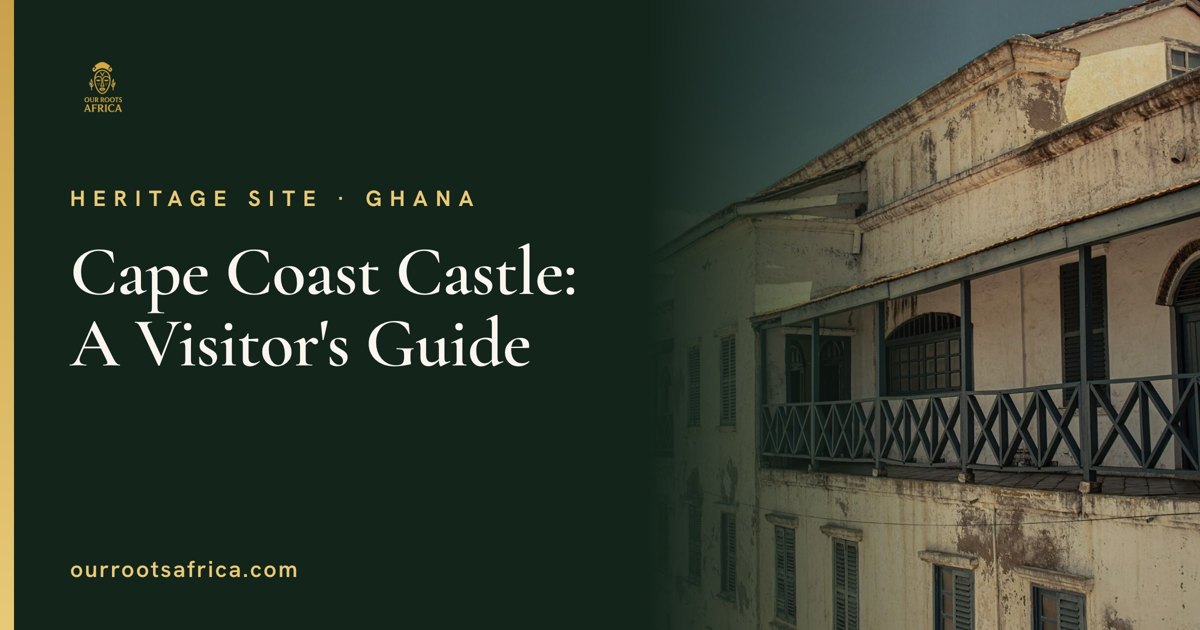
There is a small black door, the size of a single human, at the back of Cape Coast Castle on the coast of Ghana. The ocean is on the other side of it. For something like four hundred years, the last earth a captured African stood on — before being marched into the hull of a ship and carried into a world they would not name — was the threshold of that door. The Akan call it the Door of No Return. There is one at Elmina, fifteen minutes down the coast. There is a third at Bunce Island in Sierra Leone, and another at Gorée in Senegal, and another at Ouidah in Benin. If your line was taken from this coast, this is where the line broke. Going there is not tourism. Going there is a pilgrimage. This guide is for the diaspora preparing to make it.
When you walk the paths of the dungeons at these slave castles, whether it's Elmina or Cape Coast, you feel the spirits of your ancestors. You feel the suffering and the pain and just the atrocities that took place there, and you realize at that moment that you're not a descendant of slaves, but you're a descendant of survivors. — Boris Kodjoe, actor and Full Circle Festival co-founder, speaking to ABC News
Returnees often say that nothing truly prepares them for the dungeons — that the walls hold stories they could feel without anyone needing to say a word.
Why this guide exists
In our work with the heritage explorer community, the single most common complaint we hear is this: "I arrived at the castle and no one had prepared me for what would happen inside my body." The standard tour spends fifteen minutes in the dungeons. The guide reads dates. The walls are cool and damp. Then the bus moves on. For people of the diaspora — especially for the descendants of the very people who were held in those rooms — that fifteen minutes can crack a person open in a way they spend years putting back together.
This guide will not fix that. Nothing fixes it. But it will help you arrive prepared instead of ambushed. We have built it from published academic research on heritage tourism at Cape Coast (the study is cited below), trauma-informed editorial framing, and the Ghana Museums and Monuments Board's own visitor guidance for the site. It is meant to be read three times — once now, once the week before your trip, and once the night before the castle visit.
Three weeks before: the inner work
The single greatest predictor of a peaceful castle visit, in our experience, is whether the visitor has done any grief work in advance. Not perfect grief work. Any.
Sit with the names you do not know.
Light a candle. Say aloud: "I do not know your name. I do not know your village. I do not know what was taken from you. I am the one who came back." Do this for ten minutes. You will cry. That is the work — not the obstacle to the work.
The morning of
Arrive at opening time. The midday tours are crowded and rushed; the early ones are slower and quieter. Wear comfortable shoes — there are uneven steps. Take a wide scarf or wrap.
After: the five things that will happen
Your legs may give. Your chest may feel like it has weight on it. You may hear crying before you realise the sound is coming from you. You may feel nothing — and the nothing may last for weeks.
The full guide is a Walk benefit
This guide continues across seven sections — three weeks of inner preparation, the morning of, the dungeons themselves, what happens after, and how to integrate the experience on the flight home.
Three weeks before: the inner work
The single greatest predictor of a peaceful castle visit, in our experience, is whether the visitor has done any grief work in advance. Not perfect grief work. Any.
Three weeks beforeSit with the names you do not know.
Light a candle. Say aloud: "I do not know your name. I do not know your village. I do not know what was taken from you. I am the one who came back. I will witness what I can." Do this for ten minutes. You will cry. That is the work — not the obstacle to the work.
Two weeks beforeWatch one documentary. Read one chapter.
We recommend The Language You Cry In (1998) for ancestral linkage, or any chapter from Saidiya Hartman's Lose Your Mother. Skip the documentaries that retraumatize without context. Notice your body. If you cannot sleep that night, that is information, not failure.
One week beforeChoose your witness.
You should not walk into the castle alone. Choose one travel companion — or, if you are traveling solo, arrange to have a single named human (cousin, friend, therapist, anyone you trust) on call for the hour after. The brain remembers being witnessed. The witness can be on WhatsApp.
The day before
Cape Coast and Elmina are not far from Accra (about 3 hours by car, weather depending). Most heritage explorers go on a day trip. We strongly recommend against this for first visits. Sleep in Cape Coast the night before. Several small hotels in Elmina and Cape Coast cater to returnees specifically. Eat dinner early. Drink water. Do not drink alcohol. The body needs to be soft enough to feel what the rooms will tell it.
Before bed, write one short letter to your ancestors. It can be a sentence. Carry it folded in your pocket the next morning.
The morning of
Arrive at opening time. The midday tours are crowded and rushed; the early ones are slower and quieter. Wear comfortable shoes — there are uneven steps. Take a wide scarf or wrap. The dungeons are cooler than the courtyard, and the temperature shift is part of what destabilizes the body.
At the gate, ask specifically for a community-vetted guide. Some guides have been formally trained in trauma-aware tours by the Castle Museum; others have not. The cost is the same. Say: "I am from the diaspora. Please give me the long version, with time to stop." Tip generously at the end.
Inside the dungeons
This is where preparation matters most. The male dungeon at Cape Coast held up to a thousand men in a stone room the size of a small church. You can still see the line on the wall where the waste built up. You can still smell what time has not been able to clean. The guide will explain. You may need to leave halfway through. That is not weakness. That is the body telling you it is full.
- Put your hand on the wall. Published heritage tourism research, including academic interviews with visitors at Cape Coast, documents a wide range of physical responses — some intense, some quiet. Both are normal.
- Whisper a name. Yours. Your grandmother's. Your child's. Make the dungeon hear that the line did not end where they tried to end it.
- If you cry, do not apologize. The guide has seen this every day for twenty years. So has the room.
- Take the wrap off your shoulders if you can. Press it to the wall. Carry that stone-cold against your skin back into the sun.
The Door of No Return
At the end of the tour, you will be led to a small dark passage. At its end is the Door. Originally it opened directly onto the surf. Today it opens onto a fishing beach. Children play there. Boats are unloaded. A new generation moves on the same sand that took your ancestors out.
Walk through it. Walk through it knowing that you are walking the line backwards. They were taken out; you are coming in. This is the entire point of the pilgrimage. On the seaward side, on a small plaque above the door, are the Akan words: The Door of Return. Stand there long enough to be a body in a place. Then turn around. Walk back through. The threshold is now yours.
The hour after
Immediately afterDo nothing.
Sit on the wall above the dungeons. Look at the ocean. Drink water. Do not check Instagram. Do not call your mother for at least an hour. The brain needs space to file what it has just seen.
That afternoonVisit Assin Manso — the Slave River — if you can.
Inland from Cape Coast is a quieter site where captives were given their final bath in the river before being marched to the coast. Visitors often describe Assin Manso as more emotionally intimate than the castle itself — softer, less performed. Two graves of returned ancestors (Crystal and Carson, repatriated to Ghana from the US and Jamaica) lie there. Pour a libation. Spend an hour. You will be glad you did.
That nightEat with people, not alone.
Whether it is your travel companion, the family who hosted you, or a trusted person on a video call — do not eat your first dinner after the castle alone. The mind, after a day like that, can spiral. Food, conversation, and a hand on your shoulder are the oldest medicine. Use them.
If you came home with more than you can carry
Visitors often describe the months after Cape Coast as the second journey — quieter, longer, and harder. Published interviews with returnees at Ghanaian heritage sites consistently document the same delayed processing pattern. Insomnia. Tears that come unprompted. Anger at people who do not understand what you saw. This is normal. We recommend three things: a journal practice, at least one trusted person in your life who can listen without trying to fix it, and — if the symptoms persist — a therapist who has experience with intergenerational and racial trauma. When the full OurRoots.Africa preparation platform launches, post-departure integration will be one of its layers.
You went to the castle to see what was done to your family. You came home to do what your family was not allowed to do: remember.
That is the whole point. That is the entire homecoming. Welcome back.
❦
From listening to preparing.
OurRoots.Africa is an AI-powered cultural intelligence platform built specifically for the African diaspora. A sanctuary for homecoming. Join The Walk →
Join The Walk →Sources cited in this article
- Boateng, H., Okoe, A. F. & Hinson, R. E. (2018), “Dark tourism: Exploring tourist's experience at the Cape Coast Castle, Ghana”, Tourism Management Perspectives, 27, 104–110 — full text (PDF).
- OurRoots Heritage Travel Survey — November 2025, n=303 validated responses.
- Ghana Museums and Monuments Board — Cape Coast Castle site guidance.
- ABC News — “Black Americans reconnect with roots in emotional trips to Ghana's 'Door of No Return'” (Boris Kodjoe interview).