
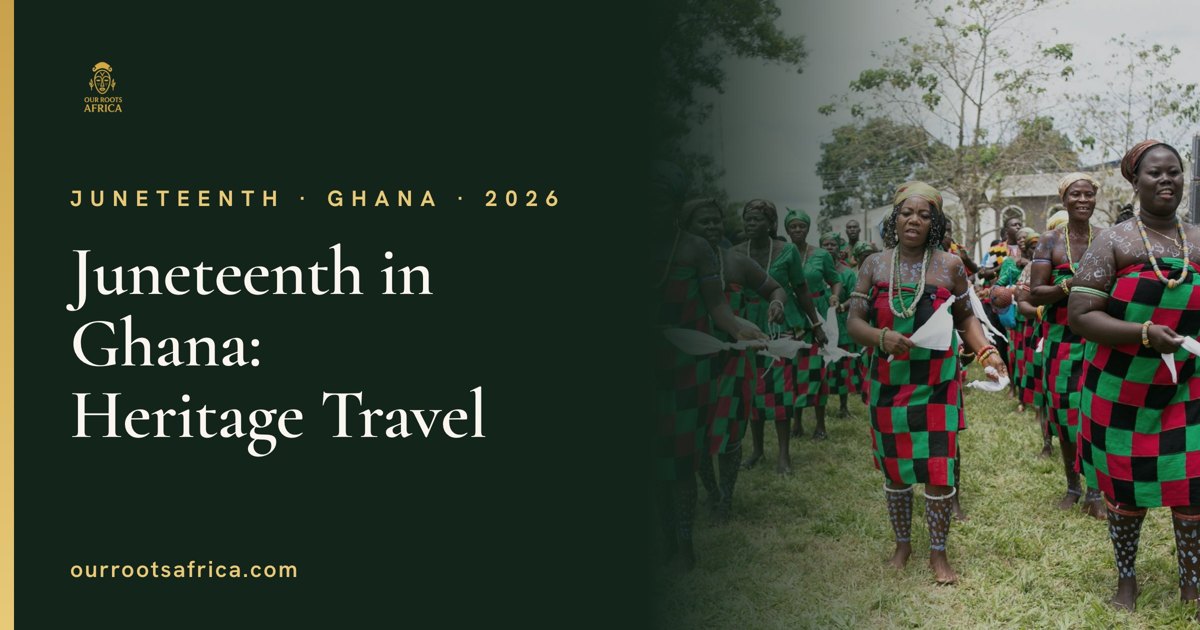
On 19 June 1865, enslaved people in Galveston, Texas — the last to be told — learned that the war was over and that they were free. The day became Juneteenth: a celebration of freedom, resilience, and survival. For generations, it was marked in churches, in backyards, in community centres in Houston and Atlanta and Oakland. In 2026, a growing number of African Americans are choosing to mark it somewhere else entirely: on the coast of Ghana, in the courtyard of Cape Coast Castle, at the river at Assin Manso.
The combination of Ghana's new open-border policy for African nationals, the growing diaspora's financial capacity to travel, and a generation asking deeper questions about identity has converged in a specific way around Juneteenth. The date has meaning. The geography has meaning. Combining them is a deliberate act.
The logic of the journey
Juneteenth marks the end of legal enslavement in the United States. But for many in the diaspora, the history does not begin in 1865. It begins earlier — at the coast of West Africa, in the dungeons of Cape Coast Castle and Elmina Castle in Ghana, in the slave river at Assin Manso, at the Door of No Return on Gorée Island in Senegal. Freedom, in this reading, is not only the end of something. It requires returning to where the thing began.
This is not a new idea. The Year of Return in 2019 — Ghana's government initiative marking 400 years since the first enslaved Africans arrived in colonial Virginia — drew over 500,000 diaspora visitors in a single year. What is newer is the precision: choosing which date to travel, and why. Juneteenth, now a US federal holiday, has given African Americans a fixed point in the calendar around which to organise a journey that was previously harder to justify to employers, families, and themselves.
What the journey actually looks like
For most people making this trip, Juneteenth in Ghana is not a package tour or a heritage excursion with a guide and a clipboard. It is something more personal. Some travel alone. Some in small groups of friends who have been planning it for years. Some with their children — choosing 19 June specifically because they want their children to be somewhere particular on that day, to understand something in their bodies that cannot be taught in a classroom.
The sites most visited are:
- Cape Coast Castle, Ghana — the largest slave-trading fort on the West African coast. The dungeons, the Door of No Return archway, the male slave dungeon beneath the governor's chapel. Many visitors choose to sit in the darkness for a period of time in silence.
- Elmina Castle, Ghana — built by the Portuguese in 1482, the oldest European building in sub-Saharan Africa. A different emotional register from Cape Coast; older, stranger, harder to read.
- Assin Manso, 40 kilometres from Cape Coast — the river where enslaved Africans bathed for the last time before being marched to the coast. The place most visitors never reach. Those who do describe it as the moment when history stopped being abstract.
- Du Bois Centre, Accra — the home and burial site of W.E.B. Du Bois, who renounced his US citizenship and died in Ghana in 1963. A quieter, more reflective site — less photogenic, more specific.
Heritage travel to slave sites surfaces emotions that benefit from preparation and, often, professional support. We recommend reading our guide to preparing for Cape Coast Castle before you travel — it was written with practitioners who have accompanied hundreds of diaspora visitors through these sites. Heritage travel surfaces things. It does not automatically resolve them. Working with a therapist or counsellor who understands diaspora identity before and after this kind of trip is worth considering seriously.
What Ghanaians make of it
This is worth asking directly, because it is a question the diaspora traveller will encounter. The relationship between continental Africans and the diaspora is not simple, and it should not be flattened into a homecoming narrative that suits only one side of the equation.
Ghana's government has, since at least 2019, actively positioned the country as the diaspora's destination of return. The tourism infrastructure around the castle sites has been built with this in mind. But within Ghana, views are more complex. Some Ghanaians are genuinely moved by the diaspora's return. Others observe it with a more sceptical eye — noting that the heritage industry sometimes positions Ghanaians as backdrop rather than participants. Others are simply indifferent. The traveller who goes prepared for this complexity — who is not seeking to be told they are home — will have a more honest, more useful experience than one who goes seeking validation.
The Juneteenth traveller who arrives at Cape Coast asking to understand something, rather than to be healed, tends to leave with something real. — OurRoots.Africa editorial note, June 2026
Practical notes for June 2026 travel
If you are planning to travel for Juneteenth 2026 specifically, several things are worth knowing:
- Flights from the US: Atlanta (ATL) has the most direct routing to Accra (ACC). New York (JFK) and Washington Dulles (IAD) have direct routes via Delta and United. Book as early as possible — June is peak season and prices reflect it.
- Visa: US passport holders still require a Ghana visa in advance. The e-Visa portal is rolling out in 2026 but availability varies by region. Apply through your nearest Ghana High Commission. Allow three weeks minimum. See our full guide: Ghana's new visa policy explained.
- Yellow fever vaccination: Mandatory. You need the international vaccination certificate (not just the jab). Get it from an authorised travel clinic — not a GP. See our Ghana health checklist.
- The $100 airport charge: In effect since May 2026. Usually included in your airline ticket. Confirm the line item when booking. See: the airport charge explained.
- Time at the sites: Do not rush. Most people underestimate how much time they will need at Cape Coast Castle. Allow half a day minimum. Many people need to sit and do nothing for a while. This is expected and appropriate.
Preparation is the difference between visiting and understanding.
The OurRoots.Africa heritage preparation platform includes a trauma-informed cultural briefing, a readiness assessment, and tools built with Ghanaians on the ground. Join The Walk to access everything before your trip.
Join The Walk →One-time payment · No subscription · No renewal · Instant access
Sources cited in this article
- Ghana Tourism Authority — visitor arrival data, 2019–2026.
- Year of Return Ghana — official government initiative documentation, 2019.
- US National Archives — Juneteenth historical record.
- W.E.B. Du Bois Centre, Accra — site information.
- Ghana Museums and Monuments Board — Cape Coast Castle & Elmina Castle.
- OurRoots.Africa diaspora travel survey, 303 respondents, November 2025.