
On 25 March 2026, in a chamber in New York, 123 countries voted to call the transatlantic slave trade what it was: the gravest crime against humanity. Ghana wrote the resolution. The United States voted against it. If this is the first you are hearing of it, you are not alone — the countries whose newspapers you read are, for the most part, the ones that opposed it or looked away.
The vote happened. It is on the record at the United Nations. And it is the kind of thing that should have led every front page and did not.
UN General Assembly resolution A/80/L.48, adopted 25 March 2026, designates the transatlantic trafficking of enslaved Africans and the system of racialised chattel enslavement as the gravest crime against humanity. It passed 123 in favour, 3 against, 52 abstentions. The three votes against were the United States, Israel and Argentina. The European Union, Canada, Australia and Japan were among those that abstained.
What the resolution actually does
It was led by Ghana and the African Union. It does two things at once. It names the crime — not as a regrettable chapter, not as a historical tragedy, but as the gravest crime against humanity, in the formal language of the body that speaks for the world's governments. And it opens the door to what comes after naming: recognition, reconciliation through truth-telling, and reparatory justice as a concrete remedy rather than an abstract demand.
Ghana's President put it in plain terms.
This resolution is a pathway to healing and reparative justice.— President John Dramani Mahama, Ghana
Two and a half months later, on 9 June 2026, Ghana's Vice-President, Professor Naana Jane Opoku-Agyemang, launched a revised National Cultural Policy at the National Theatre in Accra and pointed straight back to the resolution, describing it as work that "reinforces the role of culture in promoting justice, dignity and healing." The country that led the vote is not treating it as a one-day headline. It is building it into how it presents itself to the world.
Why most of the diaspora has not heard about this
Look again at who abstained and who voted no. The United States, where most of the African American diaspora lives. The United Kingdom and the European Union, where much of the Black British and Afro-Caribbean diaspora lives. Canada and Australia. The places where you get your news mostly stayed silent on a resolution about their own history. That silence is not an accident, and it is worth naming.
It also means the people for whom this matters most are the least likely to have heard it said out loud.
What this means if you are planning the trip
The resolution is about a place you may be thinking of standing in. Cape Coast Castle. Elmina. The dungeons beneath them are not a metaphor — they are the evidence. For the first time, the assembled governments of the world have put a name, in law, to what those rooms were for.
If you have felt the weight of this trip before you have even booked it — the sense that this is not a holiday and you are not sure you are ready — the resolution is, in its cold diplomatic way, telling you that you are not being dramatic. It took the world until 2026 to say this plainly, and a third of it still would not.
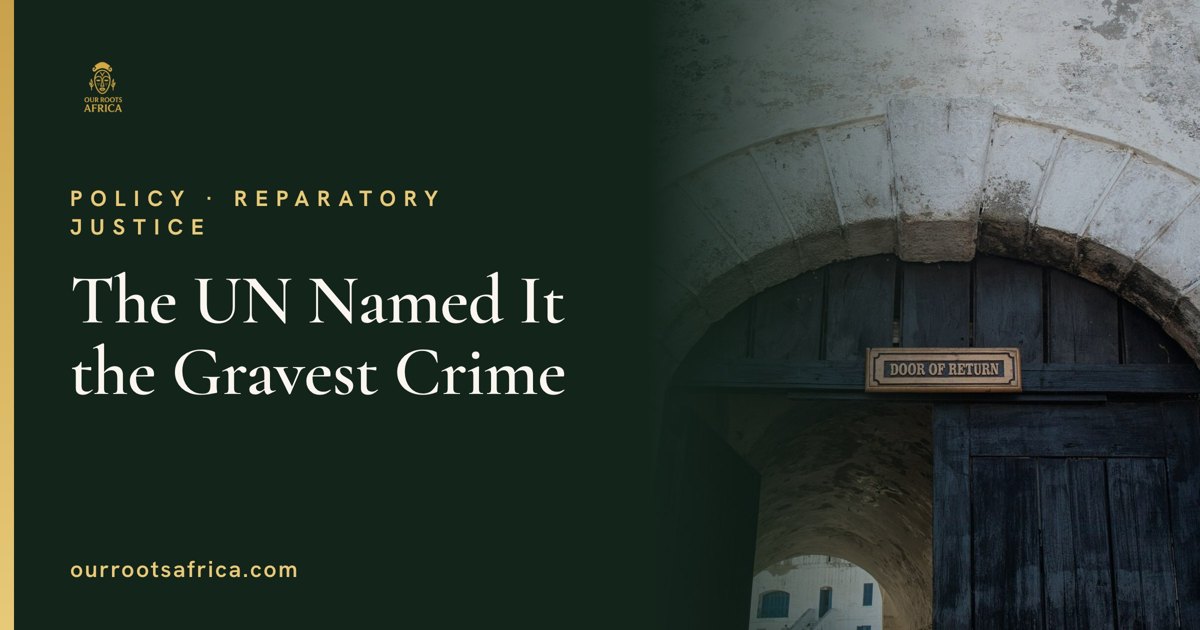
Knowing that before you walk through the Door of No Return changes how you hold it. You are not visiting a contested site as a neutral observer. You are a descendant arriving at the place the world has only just agreed to call by its true name. That is a heavier thing, and a steadier one.
One concrete step: read the resolution before you go, not after. And know that this is not finished — the UN Secretary-General is due to report back on what states actually do next.
Heritage travel can surface emotions that benefit from professional support alongside cultural preparation. We recommend working with a therapist or counsellor who understands diaspora identity.
The Heritage Preparation Pack is free.
It covers how to prepare — emotionally and culturally — for the slave castles and the journey home. Get the free pack →
Get the free pack →Sources cited in this article
- United Nations in Ghana — "Ghana Leads Historic UN Vote Declaring Slave Trade the Gravest Crime Against Humanity": ghana.un.org
- UN News — resolution on reparatory justice for the legacy of slavery, March 2026: news.un.org
- UN General Assembly resolution A/80/L.48, adopted 25 March 2026.
- Ghana Broadcasting Corporation — revised National Cultural Policy launch, 9 June 2026.